Last updated:
Check Engine Light Diagnostics in Elkridge, MD
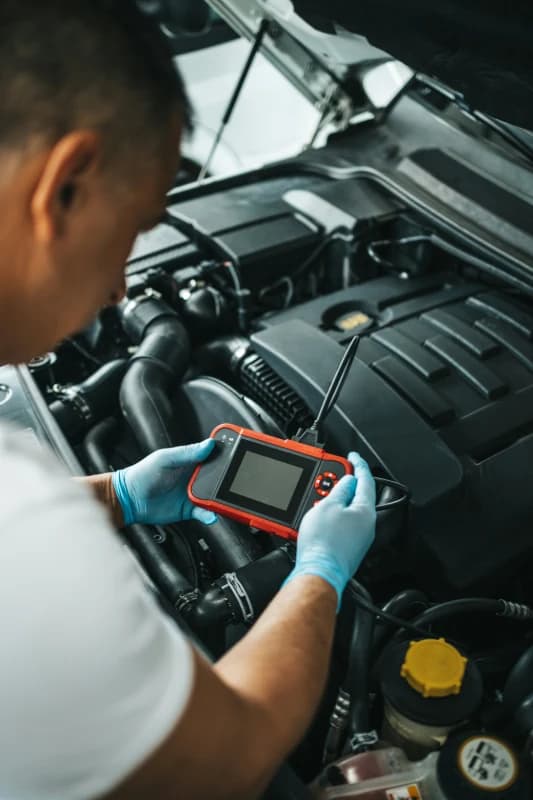
When your check engine light illuminates, it's your vehicle's way of telling you something is wrong. At API Auto Repair, our Check Engine Light Diagnostics services provide a precise computer analysis of engine codes to accurately determine the root cause of any warning lights or indicators. Our certified technicians use advanced scan tools to retrieve Diagnostic Trouble Codes (DTCs) and then perform thorough inspections and tests to confirm the issue. We go beyond just reading codes; we diagnose the underlying problem, whether it's a faulty sensor, an emissions issue, a misfire, or a more serious engine concern. We'll provide a clear explanation of the problem and recommend the necessary repairs to get your vehicle running optimally and clear that warning light.
When your check engine light comes on, your vehicle's onboard diagnostic system is telling you that something has triggered a stored fault code in the engine, transmission, or emissions control system. The light is intentionally vague — it can mean anything from a slightly loose gas cap to an active engine misfire that's actively destroying your catalytic converter. Without proper diagnostic equipment and trained interpretation, you can't tell which one you have. That's why proper check engine light diagnosis is one of the most valuable services a quality auto repair shop can provide. The savings from correct diagnosis can be enormous — we've seen customers come in with $2,000 estimates from another shop that turned out to be a $25 oxygen sensor connection issue, and we've seen others come in thinking it's nothing serious only to discover an active misfire that would have totaled the engine within a week.
Modern vehicles have hundreds of monitored parameters tracked by multiple computer modules — the ECM (engine control module), TCM (transmission control module), BCM (body control module), ABS module, SRS (airbag) module, instrument cluster, infotainment, and several specialty modules depending on your vehicle. When any of these modules detects a value outside its expected range, it sets a Diagnostic Trouble Code (DTC) and may illuminate the check engine light, ABS warning, traction control warning, or other dashboard indicators. The codes follow standardized formats — P-codes for powertrain, B-codes for body, C-codes for chassis, U-codes for network communication — and each has a specific meaning. But the meaning is starting point of diagnosis, not the conclusion. A code like P0420 (catalyst efficiency below threshold) doesn't tell you whether your catalytic converter is bad, your oxygen sensor is bad, you have an exhaust leak, you have an engine misfire contaminating the cat, or several other possibilities.
API Auto Repair uses manufacturer-grade diagnostic scan tools that go far beyond the basic code readers available at parts stores. Our tools can read all modules (not just the engine), display live data streams, perform component activation tests, run specific test sequences, and access manufacturer-specific codes that generic tools can't see. We pair the scan tool data with our experience — over thirty years of diagnostic work in Elkridge — to interpret what the data is actually telling us. Some codes are immediate fixes. Some require additional testing to isolate the actual cause among several possibilities. Some are symptoms of underlying issues that won't show up as their own codes. Diagnosis is the job, not just code reading.
Our diagnostic process is built around honesty and accuracy. We charge a diagnostic fee that covers our time and tool investment, but we credit that fee toward repairs you authorize. We never quote repairs without confirming the diagnosis through testing — guessing at parts replacement is the common shortcut that leads to customer frustration when the new part doesn't fix the problem. We provide written reports explaining what we found, what we tested, what we recommend, and what each repair option costs. If the diagnosis points to a repair we can't perform (specialized dealer-only programming, transmission rebuild beyond our scope, etc.), we tell you and refer you to the right shop.
Features
Code Reading
Retrieving diagnostic trouble codes (DTCs) from your vehicle's computer.
System Analysis
In-depth analysis of related systems to find the root cause.
Sensor Testing
Verifying the functionality of various engine sensors.
Repair Recommendation
Providing clear recommendations for necessary repairs.
Signs You Need This Service
Steady Check Engine Light Illuminated
A solid (non-flashing) check engine light indicates a stored fault code that doesn't require immediate attention but should be diagnosed within a reasonable timeframe — typically days to weeks, not months. The vehicle is generally safe to drive in this state, but performance, fuel economy, or emissions equipment may be compromised.
Flashing Check Engine Light
A flashing check engine light is an emergency indicator. It almost always means the engine is misfiring severely enough to damage the catalytic converter (a $1,500–$3,000 repair). Pull over safely as soon as possible, reduce engine load (no aggressive acceleration), and tow or call for service. Continued driving may total the engine.
Multiple Warning Lights on at Once
When several warning lights illuminate simultaneously — check engine, ABS, traction control, airbag, etc. — the underlying cause is often a network communication issue, a low battery voltage condition, or a single sensor failure cascading through multiple systems. Don't try to interpret each light separately; let us scan all modules.
Reduced Engine Power Mode
Some vehicles enter ''limp mode'' or ''reduced power mode'' to protect the engine when a serious fault is detected. The dashboard will display this and the throttle response will feel sluggish. Don't ignore it — the protection mode is preventing immediate damage and the underlying issue needs diagnosis right away.
Decreased Fuel Economy or Rough Running
Even if no warning light is on, dropping fuel economy or rough idling/acceleration can indicate a developing problem that's about to trigger codes. Many emissions and engine sensor issues cause noticeable performance changes for hundreds of miles before generating a check engine light.
Inspection Failure Due to Check Engine Light
Maryland State Inspections require all emissions readiness monitors to be set and the check engine light to be off. If your vehicle failed inspection due to an active light, we can diagnose, repair, run the necessary drive cycles, and get the vehicle re-inspected — often the same day for common codes.
Strange Smells, Sounds, or Symptoms with the Light On
If the check engine light is accompanied by burning smells, fuel smells, exhaust changes, unusual noises, or visible smoke, treat it as urgent. The combination of a code plus a sensory symptom usually means something is actively going wrong rather than just a sensor reading anomaly.
Our Service Process
- 1
Initial Consultation and Symptom Documentation
We start by asking what you've noticed: when did the light come on, was it preceded by any unusual driving conditions, are there any symptoms beyond the light itself, when did the vehicle last have major service, has anyone else worked on it recently. Customer-reported symptoms guide diagnosis efficiently — random scanning without context wastes time.
- 2
Multi-Module Scan With Manufacturer-Grade Tools
We connect a professional scan tool to your vehicle's diagnostic port and read codes from every module — not just the engine. Many problems trigger multiple codes across modules, and reading all of them gives the full picture. We document active codes (currently triggered), pending codes (about to trigger), and stored codes (historical, may be relevant).
- 3
Live Data Stream Analysis
Codes alone don't always identify the cause. Live data — real-time sensor readings while the engine runs — reveals patterns that lead to root cause. We watch oxygen sensor activity, fuel trim values, mass airflow readings, ignition timing, transmission signals, and other parameters under various conditions to see what's actually happening.
- 4
Component Activation and Bidirectional Tests
Manufacturer-grade scan tools can directly command components to activate or deactivate, allowing us to verify whether parts are working. We can fire specific fuel injectors, cycle EGR valves, command the cooling fan on, activate the EVAP purge solenoid, and dozens of similar tests. This isolates which components are functional and which aren't.
- 5
Physical Inspection of Suspected Components
Diagnostic tools point us toward likely causes; physical inspection confirms. We examine wiring connectors for corrosion or damage, check vacuum lines for cracks, inspect sensor mounting and condition, and verify physical components match what the data suggests. Many ''sensor failures'' are actually wiring or connector problems that can be repaired without replacing the sensor.
- 6
Confirmation Testing
Before recommending a repair, we confirm the diagnosis. If a sensor seems to be reading incorrectly, we verify by substituting a known-good sensor when practical, or by running additional tests that confirm the original reading is wrong rather than the sensor's response to a different problem. Confirmation prevents the ''parts cannon'' approach where shops replace components hoping to find the right one.
- 7
Written Report and Repair Estimate
You receive a written diagnostic report listing all codes found, what was tested, the conclusion, and a written estimate for the recommended repair. We explain in plain language what's wrong and why we recommend the specific fix. If multiple repair options exist (OEM vs aftermarket parts, repair vs replace), we explain the trade-offs.
- 8
Repair, Code Clear, and Drive Cycle Verification
After the repair is performed, we clear the diagnostic codes and run the required drive cycle to verify the fix. Some repairs require highway and city driving to fully reset emissions readiness monitors. We don't return the vehicle until codes have been cleared and the system has confirmed proper operation.
What's Included in This Service
Full Multi-Module Diagnostic Scan
Engine, transmission, ABS, SRS, body, and network modules all scanned for codes.
Live Data Stream Analysis
Real-time sensor data captured and analyzed against expected ranges and patterns.
Bidirectional Component Tests
Components commanded directly through the scan tool to verify operation.
Visual Inspection of Engine Bay
Wiring, vacuum lines, sensor mounting, and obvious physical issues identified.
Written Diagnostic Report
Detailed report listing codes, test results, conclusions, and repair recommendations.
Clear Explanation of Findings
Plain-language explanation of what's wrong and why; we walk through the report with you.
Repair Estimate with Multiple Options Where Applicable
Written estimate including OEM and aftermarket part options when both are available.
Diagnostic Fee Credited Toward Authorized Repairs
If you authorize repairs, the diagnostic fee is typically credited against the repair cost.
Drive Cycle Completion After Repair
Necessary highway and city driving to reset emissions readiness monitors before delivery.
Pre-Inspection Verification
If repair is for inspection failure, we verify all monitors are set and light is off before re-inspection.
Why Choose API Auto Repair
Manufacturer-Grade Scan Tools, Not Generic Code Readers
Free code readers at parts stores and basic OBD-II scanners can read generic engine codes but miss most of the data needed for real diagnosis. We invest in professional-grade tools that access manufacturer-specific codes, all vehicle modules, live data streams, and bidirectional control. The right tools mean accurate diagnosis the first time.
30+ Years of Diagnostic Experience
Diagnostic skill is built through pattern recognition over years of work. Our technicians have seen the same code on hundreds of vehicles and know what's commonly behind it on each model. That experience often saves hours of testing — we know to check specific parts on specific vehicles because we've seen the same issue many times before.
Honest Diagnosis, Not Parts-Cannon Approach
We don't replace parts hoping to fix the problem. We diagnose, confirm, then repair. If the first repair doesn't fully resolve the issue, we honor that as a continuation of diagnosis rather than charging for two separate jobs. Our goal is fixing your vehicle correctly, not running up labor hours.
Diagnostic Fee Credited Toward Repairs
Charging for diagnosis is standard practice — it covers significant tool investment, training, and time. But we credit the diagnostic fee toward authorized repairs, so customers who get the work done with us effectively pay for the diagnosis through the repair labor.
Same-Day Resolution for Most Codes
Most check engine light diagnoses can be completed within 1–2 hours. Common repairs (oxygen sensors, MAF sensors, ignition coils, gas cap replacement) can typically be performed the same day. We try to get you back on the road in one visit whenever possible.
Check Engine Light Diagnostic Pricing in Elkridge, MD
Diagnostic fees at API Auto Repair typically run $100–$150 for standard check engine light diagnosis. This covers scan tool time, live data analysis, component testing, visual inspection, and a written report. Complex intermittent issues that require extended testing or data logging may run higher — we let you know upfront if your situation requires extended diagnostic time. The fee is typically credited toward any authorized repair, so customers who repair with us effectively pay only for the actual repair work.
Repair costs vary enormously based on what's actually wrong. Simple repairs like a loose gas cap or a single bulb are essentially free at this point — we just tighten or replace and clear the code. Common emissions repairs like oxygen sensors run $150–$400 each installed. Mass airflow sensor replacement is typically $200–$500. Ignition coil replacement is $200–$500 for one or $400–$1,200 for a full set. Catalytic converter replacement runs $1,000–$2,500 depending on emissions standards and vehicle. Module reprogramming is typically $200–$400 when applicable.
We provide a written estimate before any repair work begins, and we always explain the cost difference between OEM and aftermarket parts when both are available. Some repairs (particularly emissions-related) we strongly recommend OEM parts for warranty and longevity reasons. Others (sensors, basic engine components) work fine with quality aftermarket parts at significant cost savings. We make the recommendation honestly; you make the final decision.
Tips to Extend the Life of Your Service
Don't Ignore the Light, But Don't Panic Either
A solid check engine light gives you days to weeks to address the underlying issue safely. A flashing light needs immediate attention. Either way, get the codes read within a reasonable time — letting codes accumulate makes diagnosis harder because old codes obscure the active problem.
Tighten Your Gas Cap Before Panicking
Loose or damaged gas caps are responsible for around 17% of all check engine light triggers (P0440 series codes). Tighten the cap until it clicks three times. The light may stay on for 2–3 driving cycles before the system rechecks and clears the code on its own.
Don't Disconnect the Battery to Clear Codes
Disconnecting the battery resets stored codes temporarily, but the underlying issue returns the light within days. Worse, it resets emissions readiness monitors, which means your vehicle will fail Maryland State Inspection until you complete a full drive cycle (highway and city driving).
Use Top-Tier Gasoline When Possible
Top-tier gasoline brands (Shell, Chevron, Exxon, Costco, BP, etc.) include detergent additives that help prevent injector and intake valve carbon buildup. Cheap gas without these additives can lead to drivability issues that trigger codes over time. The cost difference per fill-up is minimal compared to repair costs.
Address Small Issues Before They Cascade
A worn oxygen sensor that triggers a P0420 catalyst code can lead to actual catalytic converter damage within 6–12 months if ignored. A small misfire that triggers a P030X code can damage the catalytic converter within weeks. Fixing the root cause early often prevents the secondary damage that becomes the real expense.
Keep Records of All Repairs
Save your diagnostic reports and repair invoices. If a related issue recurs months later, the previous repair history helps narrow diagnosis quickly. We maintain customer service histories on file, but having your own copies helps with warranty claims and future shops.
Serving Elkridge & Howard County, MD
Howard County's strict Maryland State Inspection requirements make check engine light diagnosis particularly important for vehicle title transfers and registration renewals. An active check engine light is an automatic inspection failure in Maryland — there's no exception for ''harmless'' codes or recent modifications. We see customers regularly who attempt to transfer a vehicle title, fail inspection because of an unresolved check engine light, and need rapid diagnosis and repair to complete their MVA paperwork on time.
Maryland's Vehicle Emissions Inspection Program (VEIP) — separate from the safety inspection — also requires that emissions readiness monitors be set and no active emissions codes be present. After any check engine light repair affecting emissions equipment, we run the appropriate drive cycle to reset all monitors before sending you for VEIP testing. Skipping this step results in VEIP failure and an additional trip back. We have the manufacturer-specific drive cycle requirements for most vehicles and can often complete the cycle within an hour after repair.
Vehicles operated in the Howard County corridor accumulate diagnostic faults at predictable rates because of typical driving patterns. Stop-and-go I-95 traffic combined with frequent short trips around BWI airport and Fort Meade tends to produce codes related to evaporative emissions (the EVAP system relies on heat soak periods that short trips don't allow), oxygen sensor degradation (frequent rich/lean cycling accelerates sensor aging), and ignition coil failure (constant restart cycles wear coils faster than highway driving). When we see these patterns, we know the vehicle's typical use case, which speeds diagnosis.
Understanding the Top 10 Most Common Check Engine Codes
A small number of diagnostic trouble codes account for the majority of check engine light triggers. Knowing what these codes mean helps you understand your diagnostic report and make informed decisions about repairs. The most common code is P0420 (Catalyst System Efficiency Below Threshold), which appears on roughly 15–20% of check-engine-light vehicles we see. P0420 doesn't necessarily mean a bad catalytic converter — it can be caused by a worn oxygen sensor, an exhaust leak, an engine misfire contaminating the cat, or actual catalyst failure. Proper diagnosis distinguishes among these causes before recommending the $1,500+ converter replacement.
P0171 and P0174 (System Too Lean, Bank 1 and Bank 2) are extremely common. These indicate the engine is running with too much air relative to fuel, which can be caused by a vacuum leak, a failing mass airflow sensor, a weak fuel pump, or a contaminated oxygen sensor. P0300 codes (Random or Multiple Cylinder Misfire) and P0301-P0312 (specific cylinder misfires) indicate ignition or fuel delivery problems on individual cylinders. P0440 series codes are evaporative emissions issues — most often a loose or damaged gas cap, sometimes a small leak in vapor recovery hoses or a faulty purge valve.
P0128 (Coolant Temperature Below Thermostat Regulating Temperature) usually indicates a stuck-open thermostat. P0455 (Large EVAP System Leak) and P0456 (Small EVAP Leak) are evaporative system codes typically caused by gas caps, charcoal canister hoses, or vent valves. P0700 series codes are transmission-related — when you see one of these, the actual transmission code usually requires the transmission control module to be scanned separately. P2096 and P2098 (Post Catalyst Fuel Trim) often indicate a downstream oxygen sensor problem rather than a converter issue.
Network and communication codes (U-codes) are increasingly common on modern vehicles because of the complexity of inter-module communication. U0100 (Lost Communication With ECM) and similar codes can be caused by low battery voltage, corroded ground connections, water damage to wiring harnesses, or actual module failures. These codes require careful diagnosis because the same symptom can have very different fixes depending on the root cause. We have manufacturer-specific guidance for tracing network issues on most vehicles in our service area.
Why Free Code Readers Aren't Enough for Real Diagnosis
Many auto parts stores offer free check engine light scans as a customer service. The free scanners are designed to retrieve generic OBD-II codes — the standardized codes that work across all vehicles — and provide a quick description. For some customers, this is enough information to make a decision about a simple fix. For most customers, it's the start of a problem rather than the solution. The free scanners don't access manufacturer-specific codes (the most informative codes for many issues), don't read non-engine modules (transmission, ABS, body, network), don't display live data streams, don't perform component activation tests, and don't interpret context — they just print a code and a generic description.
Generic code descriptions can be misleading. ''Catalyst efficiency below threshold'' suggests the catalytic converter is bad — but the converter is rarely the actual cause on first occurrence. The free scanner doesn't differentiate between a $25 oxygen sensor connection issue, a $200 sensor replacement, a $500 sensor circuit repair, and a $1,800 actual catalyst replacement. Customers who act on free-scanner readings sometimes replace expensive parts that didn't need replacing, or fail to address the actual cause and have the same code return weeks later.
Professional-grade diagnostic equipment costs $5,000–$15,000 for tools and ongoing $500–$2,000 annual subscription fees for software updates. The investment pays off through accurate first-time diagnosis. Beyond the tools themselves, real diagnosis requires training and experience to interpret what the data is showing. Two technicians using the same scan tool on the same vehicle can come to different conclusions depending on their experience. Our diagnostic accuracy is built on three decades of work, ongoing training updates, and continuous exposure to current vehicle technology.
If you've already had a free scan and want to understand what the code means before scheduling diagnosis, give us a call at (410) 579-8422. We can usually tell you over the phone whether the code points to a likely simple fix or whether it warrants full diagnostic work. We're not trying to upsell — sometimes the right answer is ''tighten your gas cap and drive 50 miles to see if it clears.'' We'll tell you that honestly rather than insist you bring it in for paid diagnosis when it's not needed.
What Drives the Cost of Check Engine Light Repairs
When customers ask why a check engine light repair quote varies so widely between shops or between codes, the honest answer is that the underlying issue determines the cost — not the diagnostic process. Two vehicles with the same P0420 code might require completely different repairs costing $200 or $2,500 depending on what's actually happening in each system. Understanding what factors drive cost helps you evaluate whether a repair quote is reasonable. Parts costs vary primarily by manufacturer specifications. OEM parts (made by the original equipment manufacturer or to their specifications) typically cost 1.5x to 3x more than aftermarket equivalents but carry full warranty coverage and guaranteed compatibility. We use OEM for emissions equipment and major components where quality matters most, and quality aftermarket where the difference doesn't affect long-term reliability.
Labor cost depends on access difficulty. Some sensors are mounted on top of the engine and take 15 minutes to replace; others are buried under intake manifolds and take 4 hours of disassembly to reach. The labor estimate should reflect what's actually involved in the specific repair on your specific vehicle. We use industry-standard labor time guides as a baseline and adjust based on what we encounter on each car. Vehicles that have been worked on previously (poor reassembly, stripped fasteners, missing bolts) take longer; well-maintained vehicles often take less time than the labor guide suggests.
Diagnostic complexity also affects total cost. A single-cause issue with a clear repair path is straightforward. An issue caused by interaction between multiple systems — say, a vacuum leak that causes a lean condition that triggers misfires that damages catalytic converters — requires more diagnostic time and may require multiple repairs to fully resolve. We try to communicate complexity upfront when we anticipate multi-step repairs, and we charge fairly for the work involved rather than packaging unrelated issues into a single inflated quote.
Finally, parts availability matters. Most common emissions parts are stocked locally and available same-day. Some specialty parts require dealer ordering with 2–7 day lead times. European luxury vehicles sometimes require parts shipped from regional warehouses or even from Europe, with lead times of 1–3 weeks for unusual components. We tell you upfront if parts availability will affect your repair timeline, and we can usually expedite shipping when timing matters.
Reading Live Data: How Real Diagnosis Works
When we tell customers we use ''live data'' for diagnosis, we mean we read the actual real-time signals from sensors and modules while the engine runs, captures patterns under various conditions, and identifies what's behaving abnormally. This is fundamentally different from reading stored fault codes and looking up a description. Stored codes tell you what happened in the past; live data tells you what's happening right now. The combination is what makes accurate diagnosis possible. Generic free scan tools cannot display live data — they only retrieve stored codes. Professional scan tools display dozens of parameters simultaneously and can graph their behavior over time.
An example: a vehicle with a P0171 (System Too Lean) code could be caused by several different problems. Reading just the code tells us the engine is lean, which we already know from the code description. Reading live data tells us why. We watch oxygen sensor voltage, short-term and long-term fuel trim percentages, mass airflow grams per second, manifold absolute pressure, and engine RPM together. If fuel trims are positive (computer adding fuel) and mass airflow is reading low at idle but normal at high RPM, that pattern points to a vacuum leak. If fuel trims are positive across all conditions, it's more likely a fuel pump or fuel pressure issue. If mass airflow seems erratic compared to throttle position, it's the MAF sensor itself. The diagnostic conclusion changes completely based on the live data pattern.
Live data is also essential for intermittent problems. A code that only triggers occasionally — maybe once a week, maybe only when it's hot outside — is hard to diagnose because the issue may not be present when the vehicle is in our shop. Modern scan tools can ''freeze frame'' the conditions present when the code triggered (engine load, RPM, temperature, fuel trim) and store them. We can also data-log over a period of driving and review the captured data later for patterns that match symptoms. This kind of investigation takes time but produces accurate diagnoses where parts-cannon approaches fail.
Bidirectional control is another professional diagnostic capability worth understanding. Instead of just reading what sensors are doing, we can command components to operate. We can fire individual fuel injectors to verify they're working. We can cycle the EVAP purge solenoid to test for proper opening. We can command the cooling fan to run on demand. We can activate the EGR valve. Each of these tests verifies whether the component itself is functional, separating component failure from circuit failure from computer command failure. Without bidirectional control, isolating these requires hours of physical testing — with the right tools, it takes minutes.
What Happens When You Ignore a Check Engine Light
The check engine light is your vehicle's warning that something is wrong, but it's not the same as a red emergency light demanding immediate stop. Many drivers learn to ignore the light because the vehicle ''seems to drive fine.'' This is a strategy that works until it doesn't, and the failure modes can be expensive. The most common consequence of ignoring the light is cumulative damage to systems that depend on the failed component working correctly. A failing oxygen sensor that's reporting incorrect data causes the engine computer to deliver incorrect fuel mixtures, which over months degrades the catalytic converter. By the time you address the original sensor issue, you've also damaged the converter — a $1,500+ repair caused by a $250 ignored sensor.
Misfire codes that go unaddressed can total a catalytic converter within weeks under the wrong conditions. Misfires send unburned fuel into the exhaust system, where it ignites in the catalytic converter and overheats the catalyst material. Once the catalyst is damaged, no amount of misfire repair will save the converter. We've seen vehicles where a $50 ignition coil replacement at the time of code activation would have prevented a $2,000 converter replacement six months later. The check engine light's flashing mode is specifically the system warning you that this catalyst-killing damage is happening right now.
Emissions equipment failures can also affect engine longevity in less obvious ways. A failing EGR valve causes higher combustion temperatures, which accelerate engine wear and head gasket failure over years of driving. A clogged catalytic converter increases backpressure on the exhaust, which reduces engine power and over time can damage exhaust valves and turbochargers. A failing mass airflow sensor causes fuel mixture problems that can leave carbon deposits on intake valves and cylinder walls. None of these problems show up as immediate drivability issues — they accumulate as wear over months and years until something more expensive fails.
The ''it drives fine'' rationalization is also a Maryland State Inspection problem. When you eventually need to transfer a title or register the vehicle, you'll need to address the light before inspection. By then, you may have driven thousands of miles with cascading damage from the original issue. The repair cost at that point is often three to five times what the original repair would have been. The most cost-effective approach to vehicle ownership is addressing diagnostic codes when they first appear — not after you've added secondary damage.
Related Services
Electrical Diagnostics & Repair in Elkridge, MD
Electrical issues? API Auto Repair in Elkridge, MD uses advanced diagnostics to find and fix the problem fast.
Engine Tune-Up in Elkridge, MD
Boost performance and fuel efficiency with an engine tune-up at API Auto Repair in Elkridge, MD.
Fuel System Services in Elkridge, MD
Rough idle or poor MPG? API Auto Repair in Elkridge, MD offers full fuel system cleaning and repair.
Certified Maryland State Inspections in Elkridge
Need a Maryland state inspection? Visit API Auto Repair in Elkridge for fast, certified service.
Exhaust & Muffler Repair in Elkridge, MD
Noisy exhaust? API Auto Repair in Elkridge, MD fixes mufflers, pipes, and emissions systems.
Got Questions?